The Crisis of Non-Representation in Civic Democracy & the Path Back to People Power
"Unrepped" is our Urban Dictionary-worthy term for a feeling most citizens know but can't name: the experience of being unrepresented by your own political representative in government.
Repped Off? By the person elected to speak for you, who — once elected — ceases to listen to you.
Picture it this way: the moment your representative wins their seat, they put on a pair of noise-cancelling headphones. The instructions they hear come from a different channel — a club you were never a member of. The voices filtering through are those of party whips, lobbyists, major donors, and the bureaucratic machinery that was already in motion before they arrived. Your voice? That is the noise they have filtered out.
Welcome to the worst way to run a governance system.
If public servants were rated the way restaurants are — with star ratings, real-time reviews, performance metrics — no one would 'order' from this establishment. The service is slow, the menu bears no resemblance to what you asked for, and the bill arrives regardless.
How do we resolve the tension between representatives who claim to work for 'us' but increasingly work for 'the party' — or simply go with the flow dictated by the bureaucracy's perspective?
The representative system as we know it is a relatively recent and increasingly strained design. To understand its failures, we need to trace its history against the older, more durable model it displaced.
The best approach to governance, traceable throughout human history, has been the Citizen Circle — where the problems, priorities, and directions of a community are discussed, debated, and decided by the smallest unit of society: a naturally self-selected group of people from a neighbourhood or city block, where there is already common ground and shared interests.
These Community Circles are the foundational unit of group decision-making. They have been almost entirely abandoned. Allowing ourselves to drift from these deep-rooted traditions has stripped us of our agency and our voice — and left us with nothing but Electoral Performance Rituals.
From the ground up — the natural tiers of community decision-making:
| Circle Level | Scale | Role & Appointment |
|---|---|---|
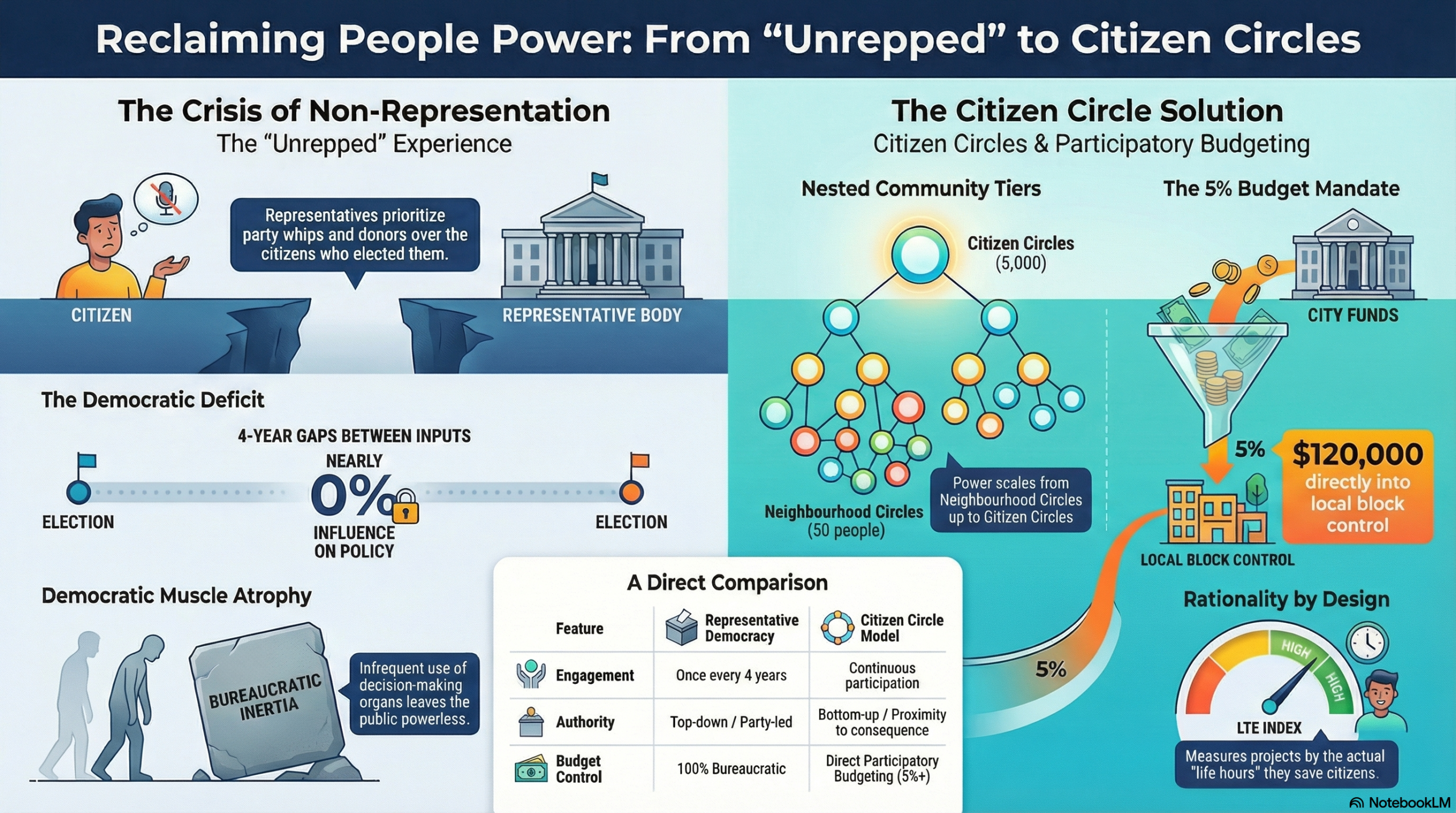
| Neighbourhood / Elder Circles* | ~50 people | Shadows & advises Neighbourhood Circles. Mentors incoming leaders and reports back down to Neighbourhood Circle Councils. |
| Neighbourhood Circles + Elders* | ~50 people | Current leadership tier (Leader & Alternate) — dynamically appointed by Neighbourhood Councils. |
| Super Block Circles + Elders* | ~500 people | Leader & Alternate — dynamically appointed by each Super Block, ratified by the Super Block Cohort. |
| Citizen Circles + Elders* | ~5,000 people | Leader & Alternate — dynamically appointed by Block Councils, representing each Block. |
Proximity to consequence is the only reliable source of good governance.
Vote once every four years. Hope your representative listens. Accept the outcomes decided by party whips, lobbyists, and bureaucratic inertia. Your voice is filtered out.
Participate continuously. Debate with your neighbours. Set priorities from the ground up. Consensus emerges from proximity to consequence — not from party allegiance.
The governance model that has proven itself across 7,000+ generations of human history operates through mediated priorities and deliberation. Decisions are filtered by rational ranked choice, constrained by the principle of subsidiarity, and guided by Civic Elders: those who have served in leadership at the neighbourhood level for at least two terms. They 'know the ropes' — not because they were appointed, but because they earned it.
In this model, the power of persuasion prevails over the persuasion by power. Consensus is built from the bottom up, not imposed from the top down.
When projects or policies fail to reach consensus at the next Circle Level up (5,000 → 500), they remain viable — if there is sufficient cooperation at the Block level, through Block-level funding or by consolidating with other Blocks across the city that share aligned priorities. Access to aggregated Community Credit Pools at successive layers — up to and including City Budgets — is extended to Blocks that vote with sufficient mandate.
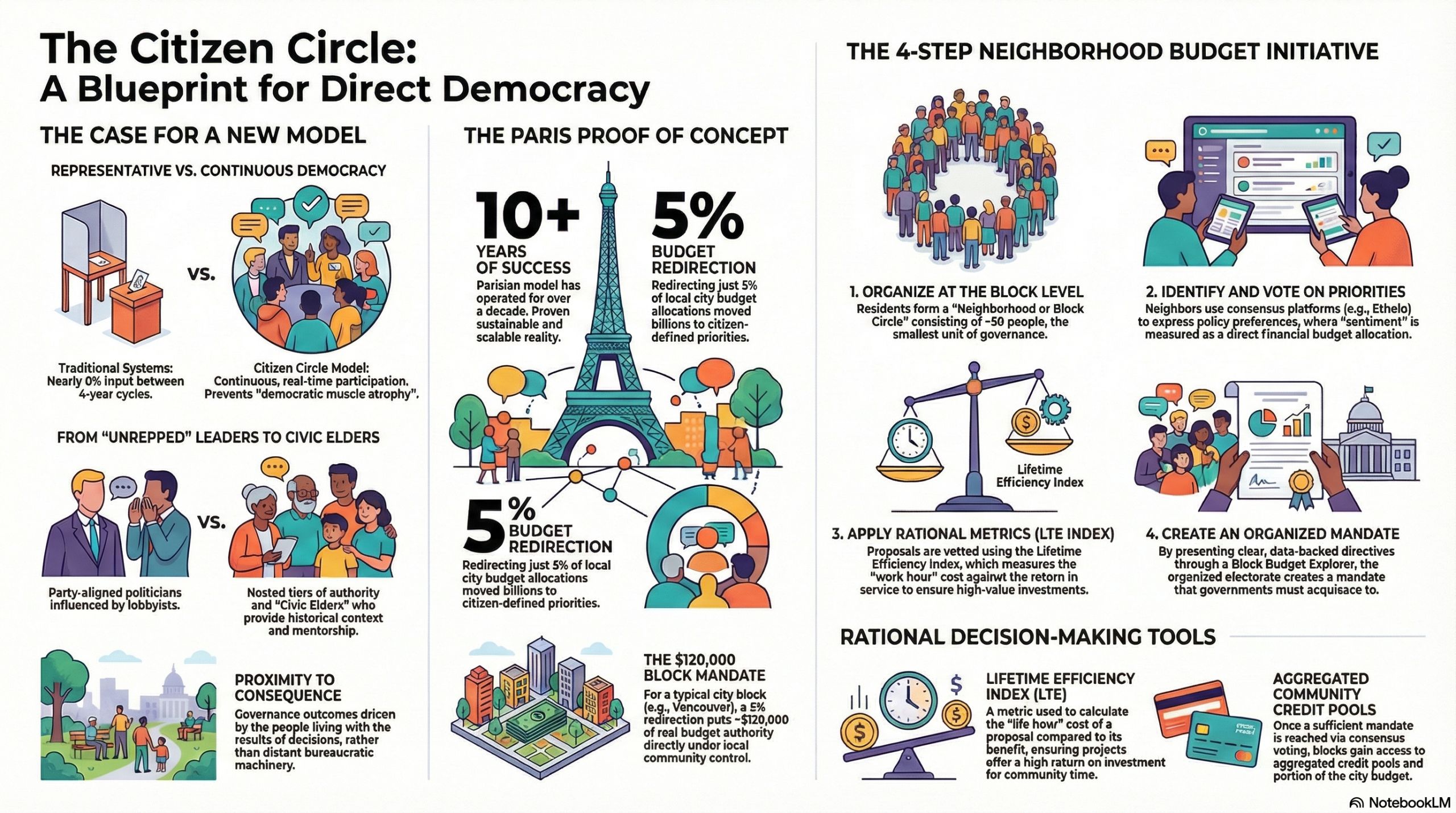
A Block receives 5% of its local city budget allocation to direct toward projects that citizens themselves vote for.
This is not a theory. The Paris participatory budgeting model has been operating this way for over ten years, redirecting billions in city spending to citizen-defined priorities.
An Electorate empowered is greater than an Electorate informed.
These nested decision processes consolidate across each Circle level so that the most common problems, priorities, and projects generate shared objectives that emerge naturally at each tier — not objectives imposed by fiat from above.
Consensus-building platforms — like Ethelo — are powerful mechanisms for policy directives to evolve in real time. The 'sentiment metric' is expressed as 'budget allocation': a common currency of preference, simply based on the percentage of your priorities you assign to each option. The feedback loop is immediate — your cohort's priorities show you, in real time, whether you are an outlier or within the consensus.
The iterative cycle allows any participant to both vote and propose a new approach. Critically, these metrics should be visible as Work Hours or Life Hours — the lifespan cost of a given proposal.
One month of work for one year of service benefit — or one month of work for five years of return.
This is the language of the Lifetime Efficiency Index (LTE) — measuring governance outcomes in terms of the actual time they cost or save from citizens' finite lives. It makes the abstract concrete, and the political personal.
If you can only express your will once every four years, you are not holding power. You have ceded it to a system that imposes its will upon you, without your consent.
The test of a good governance system is simple: does it deliver your actual policy priorities?
Whether your specific representative votes the way you want is almost beside the point. What matters is whether the system produces outcomes aligned with what you and your community actually need — and had a real voice in advocating for.
Rationality must be built into the system by design — not left to chance. 'Solutions' like 'More Police' have a proven history of being non-correlative to desired outcomes — specifically, reducing the perception or reality of risk — while alternative budget allocations that do change risk profiles or visible signals of disorder go chronically underfunded. The data is clear. The politics obscure it.
We can inject rationality through policy metrics tied to 'lifetime' cost-benefit analysis — such as the LTE Index, which provides balanced evaluation based on provable math. If a policy costs citizens more of their lives than it returns in benefit, it rationally fails the LTE test.
Unused muscles atrophy. If left unused long enough, once-functional organs become vestigial ones. The same is true of democratic institutions.
Left unchecked, the exercise of power drifts — away from 'the Power to Exercise' and toward those who simply exercise power. Unused muscles atrophy. If left unused long enough, once-functional organs become vestigial ones.
Your appendix is the classic example: a remnant of a once-functioning part of the body, now prone to infections that can kill the whole system. We frequently choose to surgically remove these troublesome anachronisms.
Extended to the body politic: frequent use of our collective decision-making organs is required to keep them functional. Otherwise, those who DO exercise power become the Dominant Power. The exercise of power through the polls is increasingly just performative — if we can only express our will once every four years, we are not holding power. We have ceded it to a system that imposes its will upon us, without our consent.
The longer this broken system persists, the more our institutional 'organs' become vestigial — no longer contributing to the body of the community — increasing the risk of infection by the virus of neoliberalism and the dictatorship of the few.
Redirect just 5% of that — $120,000 — and you bring real budget authority directly under your community's control. That is real power you can exercise today.
We have laid bare both the problem and the solution path out of the 'unrepped' quicksand — escaping the suffocating death of Democracy. Non-representation is currently a trap embedded in our political and community governance systems.
The solution is not to wait for government to fix itself. The solution is to by-pass them with Direct Democracy — and there is a very practical entry point available to every citizen today, right now.
Democracy literally means 'People Power.' We can reassert the power we actually have — regardless of whether a party elite or bureaucratic system chooses to acknowledge it.
The path is this: Vote for your Block Budget — your priorities, your projects, your policies. The participatory budgeting model, proven at scale in Paris and in dozens of cities worldwide, demonstrates that governments have no choice but to acquiesce to the policy and budget allocation directives of a sufficiently organized electorate.
If enough of us reclaim our power, no government can resist an organized electorate. Not because we overthrow anything — but because we simply begin exercising the democratic authority we already possess. The power was always ours. We just forgot how to exercise it.
The power was always ours. We just forgot how to exercise it.
Find your block. See your numbers. Not in the next election. Not after the next committee meeting. Today.