The largest privatization programme in Canadian history, pointed the other way.
In 1872, Parliament passed the Dominion Lands Act. Under its terms, the federal government offered a 160-acre quarter-section of land — free — to any settler willing to clear the forest, build a dwelling, and bring the soil under cultivation within three years. British Columbia ran a parallel programme under its own Pre-emption Act of 1860, which opened the lower mainland to the same bargain a decade before Confederation.
The scale of that bargain is difficult to overstate. Between 1872 and 1930, the Dominion Lands Survey carved 80 million hectares into 1.25 million homesteads — the largest single-system land survey grid in the world. BC's Pre-emption Act operated on the same logic until 1970. Together they did what no programme before or since has done at this scale: they took a continent held in common and distributed it, acre by acre, into private title.
The mechanism was simple. The scope was national. The direction was one-way: commons into private hands. Today there is almost no forest left to clear, the arithmetic of the original promise has collapsed, and the descendants of those settlers — along with everyone who has arrived since — now pay rent, mortgages, and grocery bills on land their ancestors were given for $10 and three years of labour.
We're running the programme again. Same mechanism. Same scope. Opposite direction.
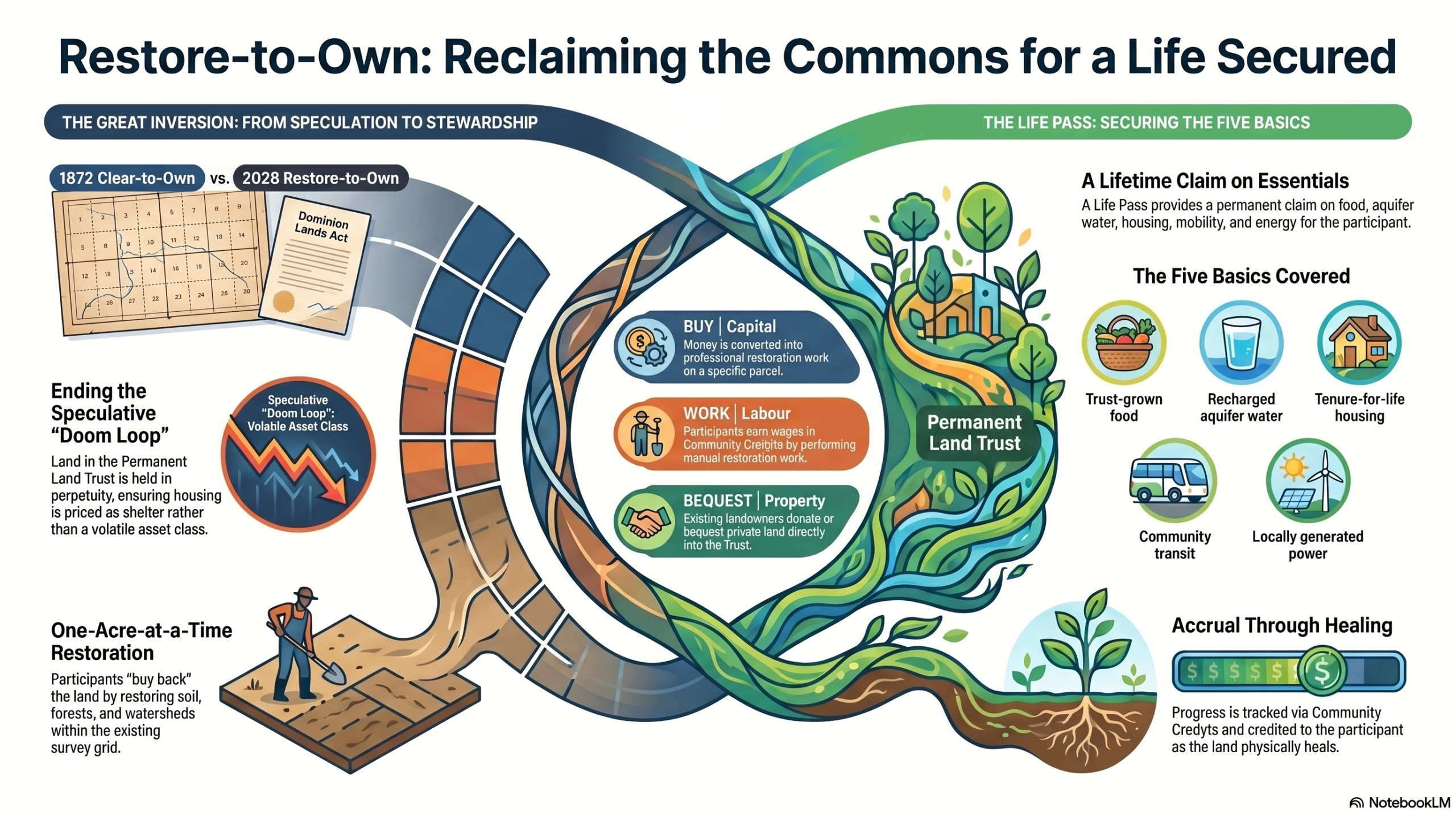
Where Clear-to-Own transferred ownership out of the commons through the mechanism of clearing, Restore-to-Own transfers stewardship back into the commons through the mechanism of restoring. The framework is already built. The survey grid already exists. The only thing we're changing is which direction the acre moves.